
The Indian rupee was off to a bad start in the new year as it suffered the worst single-day drop in over two weeks today by falling 32 paise to end at 63.35 against the US dollar.

Bajaj Finserv was the top gainer in the Sensex pack, rising over 4 per cent, followed by L&T, HDFC, Axis Bank, SBI, Reliance Industries and IndusInd Bank. NSE Nifty soared 276.30 points to its new closing peak of 17,823.

Improved credit profile may make you eligible to transfer your existing home loan to another lender at a much lower rate.
Striking a different note from its peers, US brokerage Bank of America Securities has maintained that the Reserve Bank will leave rates unchanged next week, recognising growth-focused and capex-driven fiscal expansion, which though poses huge price pressure and interest rate risks later. The RBI's rate setting panel Monetary Policy Committee (MPC) will begin its deliberations next Monday and announce the policy moves on Wednesday (February 9) in the backdrop of a massive spike in bond yields post the Budget. Almost all major central banks are in the process of hiking rates to tame inflation.

Inflation rate during August, the data for which is yet to be released, was likely to remain at about 7 per cent, said SBI Ecowrap.

'We emphasise the importance of not basing investment decisions solely on electoral outcomes.' 'Instead, focusing on investing in high-quality businesses capable of prospering regardless of the political landscape is paramount.'

The 30-share Sensex ended up 390 points at 26,637 and the 50-share Nifty closed 118 points higher at 7,961.
So far, India has attracted over $20 billion in the debt segment, thanks to the rate differential.

Brokers said investor sentiment turned choppy on selling by foreign institutional investors ahead of the September month derivatives expiry on Thursday.

Industrial countries cannot at this point wash their hands off developing economises and say we will do what we need to, and you do the adjustment you need to, says RBI Governor.

Notwithstanding concerns about lofty valuations, smallcaps recorded their most significant monthly gain in nearly three years in November. The National Stock Exchange Nifty Smallcap 100 finished the month with a 12 per cent gain, the most since February 2021 when it rose by 12.2 per cent. After declining by 4.1 per cent in the preceding month, the Nifty Midcap 100 rose by 10.4 per cent, the most since July 2022.

Eleven companies have launched their initial public offerings (IPOs) in December 2023, making this month the second-best December for public offerings since 1996. Collectively, they are raising Rs 8,182.7 crore this month. In December 2021, 11 companies raised Rs 9,534 crore. However, excluding December 2021, this month marks the best December for IPOs since 1996.

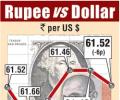
The partially convertible rupee closed at 61.2350/2450 per dollar compared with 61.31/32 on Tuesday.
The RBI's macroeconomic report released after the close of markets said upside risks to food inflation remain and that it expects the retail and wholesale price inflation to remain above comfort levels.

'The CEO will neither be able to guide the senior team in operational matters nor decide on their appointment, compensation or removal.' 'Yet, the CEO is responsible for the profit and loss of the bank!' 'Why would the senior executives listen to him?' 'Which self-respecting professional would want to be a CEO with these constraints?' asks Tamal Bandyopadhyay.

'The minimum holding period for equities should be three years.' 'Try goal-based investing.' 'Link your equity portfolios to specific goals such as retirement, purchase of a house or car...'

The 30-share Sensex ended higher by 46 points at 26,360 and the 50-share Nifty gained 16 points at 7,891.
.jpg)
The BofAML report said that five year money can be raised by issuing the 7 to 9 per cent coupon bonds to stabilise markets, just as it was done in 1998 and 2001.

After three sessions of weakness, the rupee strengthened by 50 paise against the dollar.
A weak dollar in overseas market in view of the Federal Reserve's cautious stance on interest rate strengthened the rupee value.
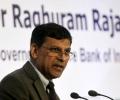
We may now be experiencing the darker side of the massive monetary stimulus of past years, said Rajan.
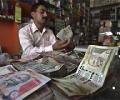
To provide exporters/importers greater flexibility in risk management, RBI enhanced the limit available to exporters to 50 per cent

IndusInd Bank was the top loser in the Sensex pack, shedding around 3 per cent, followed by Dr Reddy's, NTPC, Maruti, Axis Bank, Bajaj Auto, Bharti Airtel and HDFC. NSE Nifty declined 76.15 points to 15,691.40.

RBI staff tell Governor Urjit Patel that the central bank's image of efficiency and independence has 'gone into smithereens in no time.'
.jpg)
ITC, Infosys, Wipro and HDFC Bank among the major losers.
RBI will be cautious easing rates further given oil price uncertainties

Gold demand in India -- one of most avid purchasers -- is interwoven with culture, tradition, the desire for beauty and the desire for financial protection.

Days ahead of the annual monetary policy, trade bodies today urged the Reserve Bank not to hike its key-rates as they fear a further tightening could push lending rates up and thus hamper growth.

tailwinds of a remarkable year and handsome investor returns, Indian equities are set for an eventful journey in 2024, with a slew of local and global cues -- varying from interest rates to Lok Sabha polls to geopolitical happenings. Analysts are of the view that the bull run in the domestic equity market will continue, and over the next 3-6 months, the benchmark indices -- Sensex and Nifty -- could climb up to 7 per cent. In 2023, the 30-share BSE Sensex jumped 11,399.52 points or 18.73 per cent, and the NSE Nifty climbed 3,626.1 points or 20 per cent.
.jpg)
The RBI has bought Rs 124.62 billion worth of bonds since its announcement on Aug. 20 that it would occasionally buy bonds to relieve some of the cash tightness in the banking system.

The partially convertible rupee ended at 62.2825/2925 per dollar.

Says GDP growth rate from 2014-15 to 2015-16 will be greater than that of 2014-15 from 2013-14

Index heavyweight RIL surged 3% to end above Rs 1,000 mark while IT majors were also the top gainers.

Tata Motors was the top gainer on better-than-expected June quarter revenues

A higher opening in the domestic equity market also supported the rupee but dollar's gain against other currencies overseas limited the rise of domestic unit, forex dealers said.

The domestic currency had lost 49 paise to close at a three-month low of 60.55 on Thursday on capital outflows after the US Fed trimmed its monthly bond buying programme by another $10 billion.

RBI has cut the rates thrice so far in 2015 by 25 bps each.
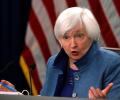
Hawkish guidance by the US Fed raises concerns it could tie the hands of RBI from trimming rates.
Experts said a future rate cut would depend on the inflation.

Investors' wealth on Thursday tumbled over Rs 2.81 lakh crore as stocks declined in line with selloff in global equities. The 30-share BSE benchmark index tanked 581.21 points or 1 per cent to settle at 57,276.94. During the day, it cracked 1,418.79 points to 56,439.36. In tandem with weak trend in equities, the market capitalisation of BSE-listed firms tanked Rs 2,81,147.38 crore to Rs 2,59,97,419.48 crore.
